Rome coffee culture: how to order like a Roman
Trastevere: Food and Drink Tour
How do Romans drink coffee and what should I order?
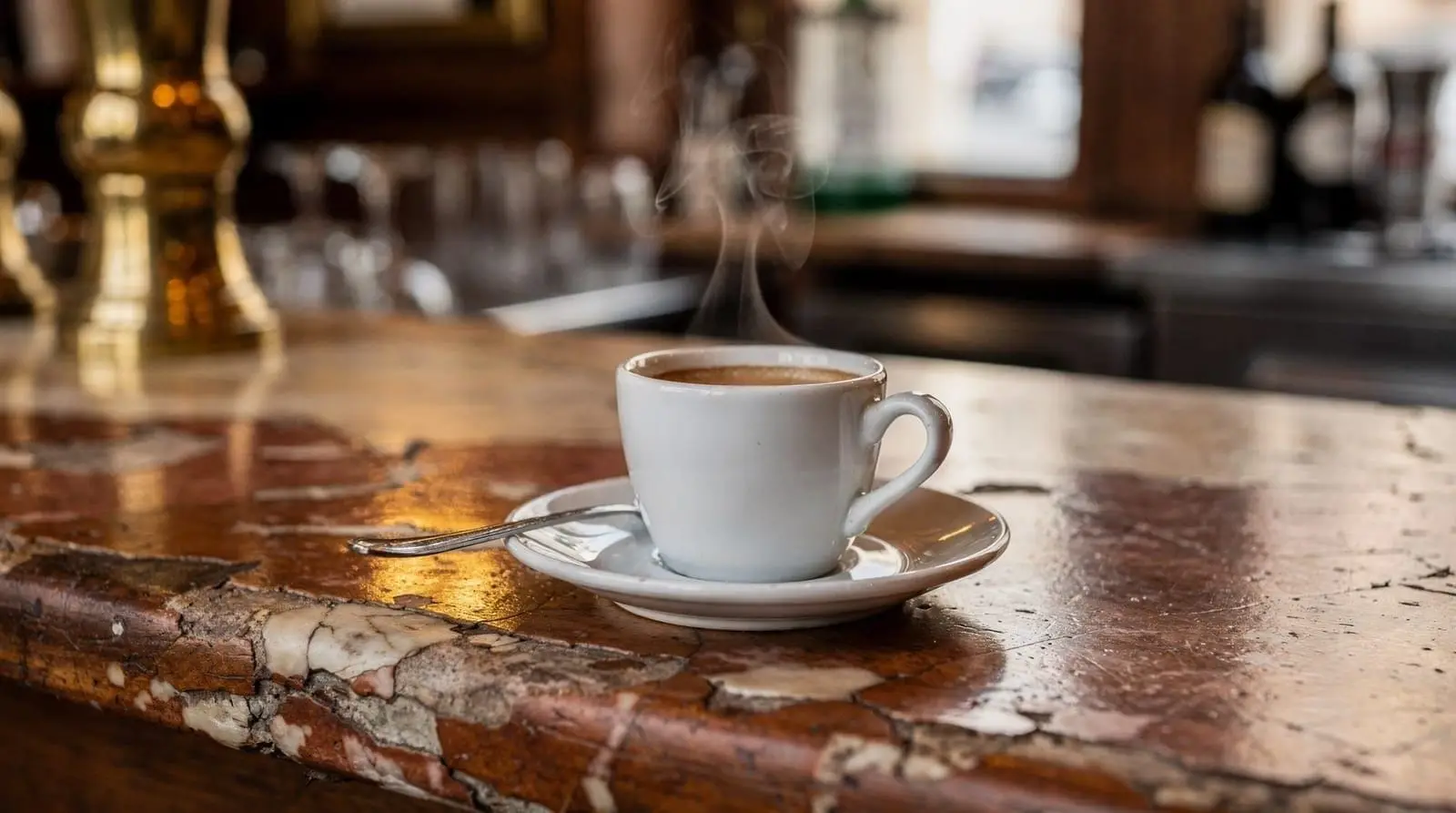
Romans drink espresso standing at the bar (al banco), pay at the counter first in busy cafes, and never order a cappuccino after 11:00. Espresso costs €1-1.50 al banco. Sit down and the price doubles. The best coffee in Rome is at Sant'Eustachio il Caffè — arrive prepared for a queue.
The Roman bar — what it actually is
In Italy, a “bar” is not primarily a drinking establishment in the British or American sense. It’s a place for coffee. The bar serves espresso, cappuccino, pastries (cornetti, maritozzi), and a selection of alcoholic drinks — but the organizing function is coffee, served fast, standing at a counter, usually consumed in under three minutes.
| Cost al banco | €1–1.50 espresso; doubles or more when seated |
| Rule of thumb | No cappuccino after 11:00 |
| Where to go | Sant’Eustachio il Caffè, Tazza d’Oro (both near the Pantheon) |
| Payment | Pay at the cassa first in busy bars, then order at the counter |
| Booking | None — walk-in only |
The rhythms of the Roman bar are specific and worth understanding:
Morning (07:00-10:30): Espresso or cappuccino with a cornetto (Italian croissant, sweeter and pastry-like) or maritozzo con la panna (sweet brioche with whipped cream). Standing at the bar. This is breakfast.
Mid-morning coffee break (10:00-11:00): Espresso. Standing. Two minutes.
After lunch (13:30-14:30): Espresso. Possibly caffè corretto (with grappa or amaro). Never cappuccino.
Mid-afternoon (15:00-17:00): Espresso, possibly a freddo (cold version in summer) or a granita di caffè.
Aperitivo hour (18:00-20:00): Transition to aperitivo — Campari, Aperol Spritz, negroni, accompanied by snacks (olive, chips, bruschetta). This is when bars become more social and the coffee focus shifts to drinks.
The vocabulary of Roman coffee
Caffè: The default order. Means espresso — a single shot of coffee extracted under pressure in about 25-30 seconds. About 30ml in the cup. Drunk immediately.
Caffè doppio: Double espresso. Less common than you’d expect — Romans prefer two single espressos over time rather than a large single dose.
Cappuccino: Espresso with steamed milk and foam. Drunk at breakfast only, by general convention. About 150ml. The milk should be silky, not frothy.
Caffè macchiato: Espresso “stained” with a small amount of warm milk foam. Acceptable at any time of day. A compromise between espresso and cappuccino.
Latte macchiato: Steamed milk “stained” with a shot of espresso — the reverse of macchiato. A children’s drink in Italy; ordering it as an adult registers as slightly unusual.
Caffè americano: Espresso diluted with hot water. Possible; available on request. Not the same as filter coffee.
Caffè corretto: Espresso “corrected” with a small shot of spirits — typically grappa, amaro (like Montenegro or Averna), or sambuca. A post-meal digestive tradition.
Caffè freddo: Cold espresso — brewed hot, then chilled and poured over ice. Standard in summer. Sometimes pre-sweetened.
Shakerato: Espresso shaken with ice in a cocktail shaker, resulting in a cold, frothy, slightly sweetened coffee. Summer only; fashionable in recent years.
Granita di caffè: Semi-frozen coffee slush, typically with whipped cream. Sicilian in origin, widely available in Rome in summer.
Decaffeinato: Decaffeinated espresso. Available at virtually all bars.
How to order at the bar
At a traditional Roman bar, particularly a busy one, there’s a protocol:
Step 1: Decide what you want before approaching. The bar moves fast; dithering holds up the line.
Step 2: In some busy bars, pay at the cassa (cash register, usually separate from the bar) first. Take your receipt (scontrino) to the bar counter. In smaller neighborhood bars, you typically order at the bar and pay at the end.
Step 3: Approach the counter, make eye contact with the barista, and order clearly. Say “un caffè, per favore” or “un cappuccino.” The barista will make it immediately.
Step 4: Drink at the counter. The standing position (al banco) is the correct one. Linger if you like, but don’t claim counter space indefinitely when there’s a queue.
Step 5: If you want sugar, it’s in a small container at the counter. Stir once, don’t tap the spoon on the cup (considered bad form), and drink.
The al banco vs. sitting distinction matters for budget: at a famous cafe like Sant’Eustachio, espresso al banco is €1.50; at a table on the piazza, it’s €4+. The coffee is identical.
The best coffee in Rome
Sant’Eustachio il Caffè
Piazza di Sant’Eustachio 82, near the Pantheon
The most famous coffee in Rome. The origin story involves a secret roasting process (the roasting room has been hidden from public view since the cafe opened in 1938), coffee sourced from multiple origins and blended in-house, and a particular technique of pre-sweetening the espresso by incorporating sugar into the preparation rather than adding it afterward.
The result is distinctive: a dense, persistent crema, a sweetness that’s integrated rather than added, and an intensity that’s strong without bitterness. Whether it’s “the best” depends on your preference — some serious coffee people find it over-sweetened. What’s indisputable is that it’s consistent and has been consistently good for over 80 years.
Important: The default espresso here is sweetened (zuccherato). If you want it without sugar, say “amaro” (bitter) when you order: “un caffè amaro, per favore.”
Expect a queue at peak hours (09:00-10:30, 13:00-14:00). The bar moves efficiently; a 10-minute queue is typical.
Price: €1.50 al banco.
Tazza d’Oro
Via degli Orfani 84, near the Pantheon
Sant’Eustachio’s perennial rival. Tazza d’Oro sources primarily from Brazil and blends a sweeter, slightly less intense espresso than Sant’Eustachio. The house specialty is the caffè freddo (cold espresso, served in summer) and the granita di caffè con panna — considered by many to be the best version in Rome.
The bag of freshly roasted beans from Tazza d’Oro is one of the better souvenirs you can bring from Rome.
Price: €1-1.50 al banco.
Caffè Greco
Via Condotti 86, near the Spanish Steps
Rome’s oldest cafe, in operation since 1760. Keats, Goethe, Stendhal, Wagner, and Lord Byron all drank here. The interior has been preserved with neoclassical paintings and red velvet banquettes that look like they haven’t changed since the 19th century.
The coffee is good; the experience is historical. The sitting price (€7-9 for a cappuccino at a table) is partly paying for the context. Go once, stand at the bar, and drink it for €2.
Roscioli Caffè
Piazza del Biscione 39, near Campo de’ Fiori
The cafe arm of the Roscioli brand (which also runs a famous deli and restaurant nearby). More modern in aesthetic than Sant’Eustachio or Caffè Greco, with a focus on sourcing transparency — they publish the farms and origins for their coffees.
Worth visiting for the maritozzo, which is one of Rome’s better versions, and the naturally leavened croissants. The coffee is excellent by any serious standard. Less of a queue than Sant’Eustachio.
Bar San Calisto
Piazza di Santa Calisto 3, Trastevere
Not a destination for coffee quality — the espresso is competent but unremarkable — but worth knowing as a Trastevere institution. It’s one of the last old-school bars in the neighborhood that hasn’t been redesigned for Instagram. The standing-room crowd on summer evenings is entirely local. Cheap drinks, paper cups on the terrace, no pretension.
Neighborhood coffee stops worth knowing
For Vatican visitors: Bar Floreria (Via della Conciliazione) is acceptable but tourist-facing. Better: walk five minutes to Prati and find a neighborhood bar — any one on Via Cola di Rienzo is fine and cheaper.
For Colosseum/Monti visitors: Café Lit (Via Leonina) in Monti has a decent espresso and good cornetti. Avoid the tourist bars immediately outside the Colosseum.
Near Termini: The station bars (inside Termini) are serviceable for a quick espresso before catching a train — not destinations in themselves, but functional.
In Testaccio: Bar Barberini (Piazza di San Marco area) and a handful of unnamed neighborhood bars near the Mercato di Testaccio serve the market workers and residents. No tourist premium.
In Trastevere: Beyond Bar San Calisto, most bars along Via della Scala and Via del Moro serve competent, fairly priced espresso — the Trastevere food guide has the fuller neighbourhood picture for pairing coffee stops with meals.
In the Centro Storico: Away from the two famous rivals near the Pantheon, the Centro Storico guide covers smaller bars on quieter side streets with none of the piazza-facing markup.
The specialty coffee scene
Rome has been slower than Milan or Naples to develop a specialty (third-wave) coffee culture, but it exists. A handful of shops now do pour-over, aeropress and cold brew alongside traditional espresso.
Faro (Via Piemonte 39, near Via Veneto): one of Rome’s first specialty coffee shops, with a rotating selection of single-origin beans and filter brew methods alongside espresso. The space is calm and work-friendly.
Sciascia Caffè (Via Fabio Massimo 80, Prati): a traditional bar that also does excellent single-origin espresso. The granita in summer is exceptional.
Barnum Café (Via del Pellegrino 87, near Campo de’ Fiori): a relaxed, work-friendly space with better-than-average espresso and a good pastry selection.
Aperitivo — the transition
From approximately 18:00 onward, the Roman bar transitions to aperitivo. This is when negroni, Campari soda, Aperol Spritz and amaro take over from espresso. Many bars put out small snacks — olive, bruschetta, chips — which are included with the drink.
The aperitivo is not a full meal (unlike the Milanese “apericena”), but it bridges the gap between afternoon and the late Roman dinner hour (20:00-21:30). Budget around €8-15 per cocktail at a bar, inclusive of snacks.
For a guided introduction to both the food and drink culture of Rome’s neighborhoods, a food tour covers the coffee and aperitivo landscape alongside the eating:
The Trastevere food and drink tour includes stops at traditional bars and wine spots alongside the food tastings — the fastest way to understand the neighborhood’s drinking culture.The coffee-to-go question
Romans generally do not drink coffee while walking. A coffee bought at the bar is drunk at the bar. This is partly cultural (the point of the bar stop is a 3-minute pause in the day) and partly practical (espresso in a tiny cup doesn’t travel well).
Takeaway coffee cups exist and are used by tourists. Some shops now offer them. But ordering “da portare via” (to take away) may earn you a slightly confused look at a traditional bar, and definitely won’t get you the speed that marks the Roman bar experience.
For how coffee fits into the broader eating culture — the morning pastries, the post-lunch digestivo, the transition to aperitivo — see our where to eat in Rome guide. For the gelato that sometimes accompanies the coffee break, see our gelato guide.
Coffee economics — what you’re actually paying for
Rome has a well-established two-tier pricing structure for coffee: al banco (at the bar, standing) and ai tavoli (at a table, seated). This is not unique to Rome — it’s standard across Italy — but the gap is wider in tourist-heavy central Rome than almost anywhere else in the country.
Legal requirement: Bars are required to display both prices on their price list (listino prezzi), usually posted near the entrance or the cash register. If you sit down at a bar and there’s no visible price list, you’re technically within your rights to ask before ordering. In practice, at tourist-facing locations, the seated price is assumed.
Typical price differential:
- Neighborhood bar in Testaccio or Prati: espresso al banco €1-1.20, ai tavoli €2-2.50
- Mid-range bar near the Pantheon: espresso al banco €1.50-2, ai tavoli €3-5
- Tourist-facing terrace bar at Piazza Navona or Via Condotti: espresso ai tavoli €5-8
The coffee in the cup is often identical — you’re paying for the seat, the view and the theater.
The rational approach if you’re on any kind of budget: drink standing at Sant’Eustachio or Tazza d’Oro, then take a walk with your coffee still tasting in your memory while looking at whatever you came to look at. For more on stretching a Rome trip’s daily spend without cutting the good parts, see our Rome on a budget guide.
The Roman morning routine — a practical guide
The Roman breakfast routine is efficient and worth understanding if you want to blend in:
- Walk into a bar. If it’s busy, go to the cassa (cash register) first and pay for your order — then take the scontrino (receipt) to the bar counter and repeat the order.
- Order: “Un caffè” (espresso) or “Un cappuccino” and “Un cornetto” (croissant — sweeter and more brioche-like than French, typically filled with jam, custard or Nutella). Or a maritozzo if it’s available.
- Eat and drink at the counter. This takes 3-5 minutes.
- Leave the receipt (or the small coins of change) on the counter as a slight gratuity — optional but appreciated.
The whole interaction, including the 5 minutes of coffee and pastry, costs €2-4 al banco. It’s one of the best values in Rome.
What not to do:
- Don’t sit down and then look surprised when the bill is double.
- Don’t ask for a “latte” without specifying — in Italian, “un latte” means a glass of milk.
- Don’t order a cappuccino after 11:00 if you want to be taken seriously.
- Don’t stand at the counter for 20 minutes checking your phone — al banco means drink and go.
Pastries that pair with your coffee
A Roman coffee stop is rarely just coffee — the pastry counter is part of the ritual, and knowing what to order alongside your espresso or cappuccino improves the whole experience.
Cornetto: The standard morning pastry, sweeter and more brioche-like than a French croissant. Comes plain (vuoto), with apricot jam (albicocca), custard (crema), or Nutella (cioccolato). Best eaten fresh from the morning batch — bars that bake in-house (rather than reheating frozen dough) are noticeably better, and usually smell like it from the door.
Maritozzo con la panna: A soft, slightly sweet brioche bun split and filled generously with whipped cream — a genuinely Roman specialty rather than a national one, though it has spread across Italy in recent years. Roscioli Caffè’s version is among the best in the centre.
Cornetto integrale: A whole-wheat version, slightly less sweet, offered at most bars as a marginally healthier option — still very much a pastry, not health food.
Ciambella and biscotti secchi: Simple ring-shaped cakes and dry biscuits, less common at bar counters but often available for a plainer, less sweet accompaniment to an afternoon espresso.
The etiquette matches the coffee ritual: choose your pastry from the display case or point it out to the barista, eat it standing at the counter, and expect the whole interaction — coffee, pastry, payment — to take under five minutes.
Useful Italian for ordering coffee
| What you want | What to say |
|---|---|
| Espresso | ”Un caffè, per favore” |
| Espresso without sugar | ”Un caffè amaro, per favore” |
| Double espresso | ”Un caffè doppio” |
| Cappuccino | ”Un cappuccino” |
| Espresso with cold milk | ”Un caffè macchiato freddo” |
| Espresso with hot milk foam | ”Un caffè macchiato caldo” |
| Cold espresso | ”Un caffè freddo” |
| Espresso with spirits | ”Un caffè corretto — con grappa / con amaro / con sambuca” |
| Decaf | ”Un decaffeinato” |
| Standing at bar | ”Al banco” |
| Seated | ”Al tavolo” |
For the rest of the food and drink culture context, see our street food guide and where to eat in Rome.
Frequently asked questions about Rome coffee culture: how to order like a Roman
What does 'al banco' mean in a Roman bar?
Why don't Romans drink cappuccino after lunch?
What is the correct thing to order at an Italian bar after lunch or dinner?
How much does coffee cost in Rome?
What is Sant'Eustachio il Caffè famous for?
What is a 'granita di caffè'?
What is the 'caffè sospeso' tradition?
Can I get filter coffee or an Americano in Rome?
Top experiences
Bookable activities with verified prices and instant confirmation on GetYourGuide.