Pizza al taglio in Rome: the by-the-slice guide
Rome: Trastevere & Campo de Fiori Street Food Walking Tour
What is pizza al taglio and where should I eat it in Rome?
Pizza al taglio is Roman pizza sold by the cut and priced by weight — you point to what you want, it's cut and weighed, and you pay per 100g (typically €3-5/100g). Bonci Pizzarium near the Vatican is the most celebrated shop; Forno Campo de' Fiori is the historic choice for pizza bianca. Most quality shops have a rapidly rotating selection — arrive at lunch for the widest variety.
What pizza al taglio actually is
Pizza al taglio — pizza by the cut — is Rome’s contribution to the global pizza conversation. It’s a different discipline from Neapolitan pizza in almost every dimension: different dough, different baking method, different size, different buying ritual. Understanding the difference helps you appreciate why Romans talk about it with the same seriousness that Neapolitans bring to their version.
| Cost | Around €3–6/100g; a lunch portion is €7–18 |
| Where | Pizzarium (Vatican area), Forno Campo de’ Fiori, neighborhood forni |
| Best time | 12:00–13:00 for the widest selection |
| How to order | Point, gesture the amount, it’s cut and weighed |
| Not to be confused with | Round Neapolitan pizza or Sicilian sfincione |
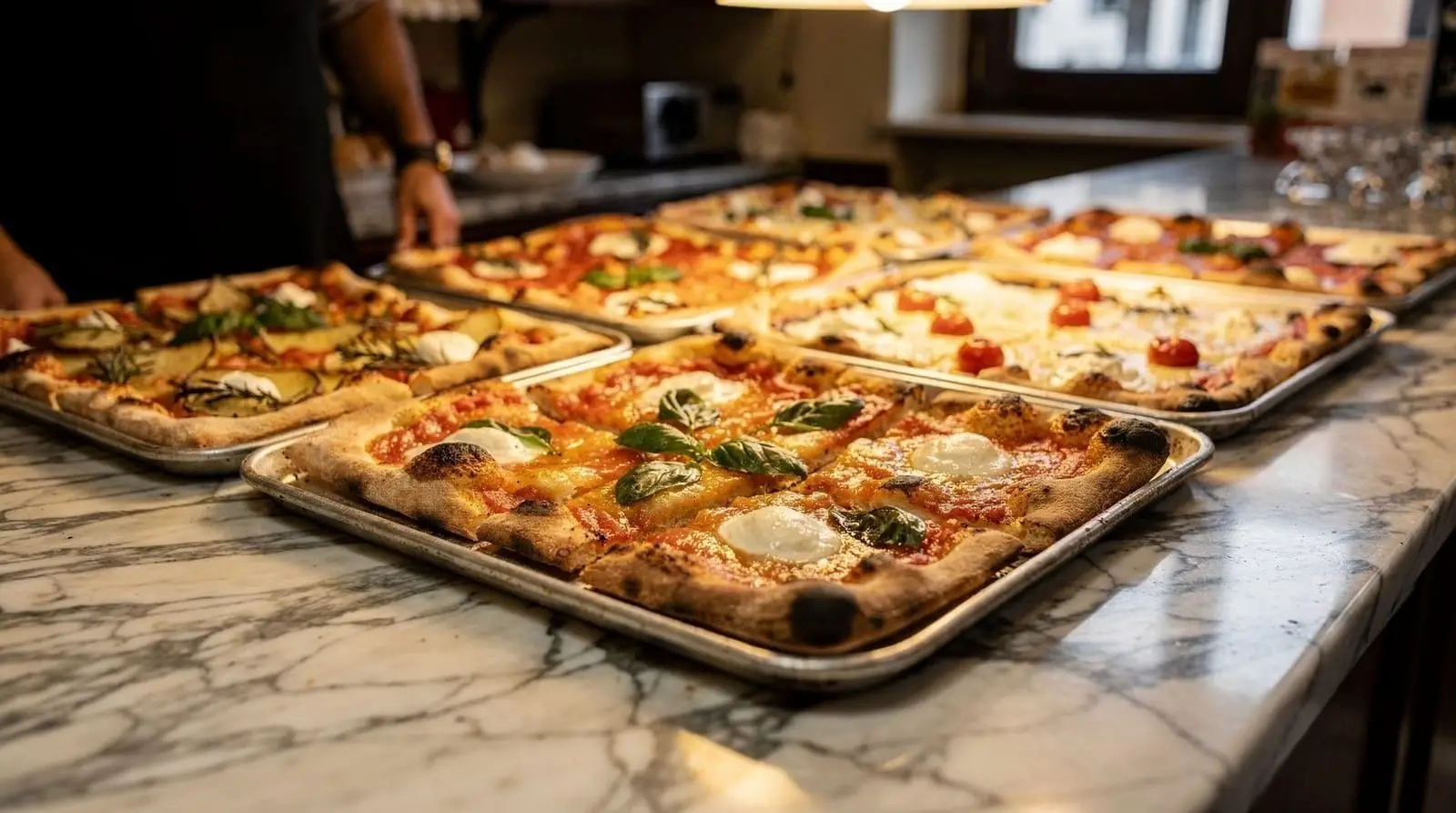
The basics: al taglio is baked in large rectangular sheet pans in an electric or gas deck oven, at temperatures around 280-320°C — lower than a Neapolitan wood-fired oven, longer in contact with the pan, producing a bottom crust that’s crispy and slightly chewy rather than charred. The dough is typically wetter (higher hydration) than Neapolitan, creating a more open crumb structure inside. The result is a thick-ish, airy, almost focaccia-like base with a golden, crispy bottom.
The buying ritual is part of the culture. You walk up to the counter, point to a section, indicate your desired amount with hands, watch the piece get cut, weighed and priced, and pay. You eat standing at the counter, at an outside ledge, or while walking. This is lunch for Romans who have 20 minutes, not tourists looking for an “experience.”
The dough: why it matters
Most of what separates good al taglio from mediocre al taglio is the dough. Specifically: hydration, fermentation time, and flour quality.
High hydration: Good al taglio dough contains 70-80% water relative to flour weight. This creates more steam during baking, which produces the large air pockets visible when you look at a slice from the side. Low-hydration doughs produce a denser, less interesting crumb.
Long fermentation: Fermentation develops flavor and creates the gluten network that holds the air bubbles. Quality shops cold-ferment their dough for 24-72 hours. Quick doughs fermented for a few hours produce flat, uniform, slightly gummy pizza.
Flour: The best Roman al taglio uses a mix of flours — sometimes including ancient grain varieties or semi-whole wheat — for flavor complexity. Industrial shops use single-type commercial flour.
You can identify the difference visually: look at the crumb (the interior) of a slice. Large, irregular air pockets indicate proper hydration and fermentation. A dense, uniform interior with small regular holes indicates a quick commercial dough.
A quick five-second quality check before you order: look at the case rather than just the menu board. A good shop displays whole trays with visible variation in colour and blistering across the surface — a sign that toppings and bake times are varied and attended to. A shop where every tray looks uniformly orange and glossy is more likely reheating or using shortcuts. If you can, ask (or simply watch) when a tray came out of the oven; a tray that has clearly been sitting under a heat lamp for hours will have a slightly collapsed, greasy look compared to one fresh from the deck oven.
Pizzarium (Bonci Gabriele) — the reference point
Via della Meloria 43, near Ottaviano-San Pietro metro
Gabriele Bonci opened Pizzarium in 2003 and changed the understanding of what al taglio could be. His innovations were both technical and aesthetic:
Technical: Long cold fermentation (48-72 hours), high hydration (80%+), blend of flours including some ancient grains. The resulting crust has an exceptional open crumb and a bottom that’s crispy enough to handle without collapsing, with a slight chew that distinguishes it from the cardboard bases of lesser shops.
Aesthetic: Toppings sourced seasonally from small producers — not just the standard margherita and bianca, but combinations like burrata with mortadella and pistachios, lardo with honey and walnuts, potato with guanciale and rosemary. The combinations rotate daily; the seasonal specials in autumn and spring are particularly strong.
What to expect: A queue. It forms at the door, particularly 12:00-13:30. The line moves in 10-15 minutes. Once inside, point to what you want from the case — ask if you can’t see what the options are. The serving staff speak enough English to take orders. Pay at the counter.
Price: €4-6/100g depending on toppings. A satisfying lunch is 250-300g — €12-18. Yes, it’s more expensive than ordinary al taglio; you’re paying for the dough and the ingredients.
Getting there: Ottaviano-San Pietro metro station (Line A). Walk 3 minutes east. The shop is identifiable by the queue.
Hours: Generally 11:00-22:00. Closed Sundays.
Forno Campo de’ Fiori — the historic institution
Campo de’ Fiori 22
The bakery on the Campo de’ Fiori market square has been baking since the 1920s. It does one thing exceptionally well: pizza bianca.
Pizza bianca is the elemental Roman white pizza — dough, olive oil, coarse sea salt, rosemary. No tomato, no cheese. It’s the foundation of Roman pizza culture, the thing Roman schoolchildren eat as merenda (afternoon snack), the thing Romans buy to eat on the way home. In good weather, buy a piece and eat it while watching the Campo de’ Fiori market.
The version at Forno Campo de’ Fiori is made correctly: proper olive oil (you can smell it), fresh rosemary, good salt distribution, a crust that has the appropriate balance of crispy top and chewy interior.
Price: €1.50-2 per slice — cheap for the quality and location.
What else they do: Pizza rossa (tomato, no cheese), seasonal variants, and — on Fridays — baccalà fritto (fried salt cod), which is a tradition worth building a morning around.
Note on the Campo de’ Fiori itself: The market ringing the square has shifted heavily toward tourist trinkets. The forno is one of the few original commercial establishments remaining on the square.
Other good al taglio shops by area
Prati (near the Vatican)
Angelo e Simonetta (Via del Gracchi, no specific number — look for the line): a neighborhood shop serving Prati residents, not tourists. Good rotation of toppings, consistent quality, slightly cheaper than Pizzarium. The lunch crowd is office workers, which is always a good sign.
Pane e Salame (Via del Boschetto, Monti) is technically in Monti but worth knowing: they do pizza bianca stuffed with mortadella — the canonical Roman sandwich. €4-5 for a satisfying piece.
Testaccio
Panificio Terenzi (Via Nicola Zabaglia): a neighborhood bakery that does reliable pizza bianca and al taglio for the Testaccio market crowd. Not a destination in itself, but excellent if you’re already at the Mercato di Testaccio.
Monti
Pizzeria Formula Uno (Via degli Equi 13): primarily a sit-down pizzeria, but they sell al taglio at lunch. The neighborhood regulars use it as a quick lunch stop.
Trastevere
Trastevere is not primarily an al taglio neighborhood — the sit-down trattorias dominate. For al taglio specifically, you’re better served by going to Pizzarium (20 minutes by tram) or finding a neighborhood forno.
Centro Storico
Pizzeria Baffetto (Via del Governo Vecchio 114): not al taglio in the rectangular sense, but worth noting for the round pizza romana (thin crust) that’s also a Roman tradition. Cheap, basic, honest. The queue after 20:00 tells you it’s doing something right.
Vegetarian and dietary considerations
Al taglio is generally easier to navigate for vegetarians than many other Roman dishes, since pizza bianca, pizza rossa, and vegetable-topped varieties (zucchini flower, potato, mushroom, artichoke depending on season) are standard menu items rather than special requests. Vegan visitors should ask specifically, since pizza bianca is typically vegan by default (dough, oil, salt, rosemary, no dairy) but this is worth confirming shop by shop, as some bakeries brush a butter-based glaze on certain trays. Gluten-free al taglio is rare and not a standard offering at the shops named here; if this is a hard requirement, check ahead rather than assuming a substitute will be available.
Pizza bianca with mortadella — the Roman sandwich
One of the most satisfying things you can eat in Rome costs €4 and takes 30 seconds to prepare: pizza bianca, split and stuffed with mortadella. The olive oil and salt of the bianca against the gentle fat of the mortadella is a combination that Romans grew up eating.
Find it at:
- Forno Campo de’ Fiori (make your own — buy bianca, mortadella is available inside)
- Most neighborhood bakeries (ask for “pizza bianca con mortadella”)
- Antico Forno Roscioli (Via dei Chiavari 34): slightly upmarket version using better-quality mortadella
Making pizza yourself
If you want to understand al taglio from the inside, Rome has a strong cooking class market. The traditional pizza-making classes cover the round oven-baked version (more Neapolitan-influenced) rather than the rectangular al taglio style.
A traditional pizza cooking class near Piazza Navona — covers dough, technique and toppings in a professional kitchen, with the pizza you make as dinner. A combined pizza and pasta class — covers both disciplines in a 4-hour session with wine throughout. Good for understanding the difference between pizza and pasta cooking techniques.Seasonal toppings worth knowing
Roman al taglio shops change their topping repertoire seasonally. Worth seeking out:
Spring (March-May): Carciofi (artichoke) topping, pea and ricotta, zucchini flowers with anchovies and mozzarella (fiori di zucca), fresh asparagus.
Summer (June-August): Cherry tomato and basil, eggplant caponata, prosciutto and figs (mid-August onward).
Autumn (September-November): Porcini mushroom, chestnut and speck, pumpkin with gorgonzola.
Winter (December-February): Radicchio and taleggio, broccoli romanesco with anchovies, sausage and broccoli.
What to avoid
Pizza sold by the slice at a fixed flat price near tourist monuments. If you’re near the Colosseum, the Trevi or the Pantheon and a place is selling “pizza by the slice” for €4 each regardless of weight or topping, you’re in a tourist-trap zone. The pizza will be pre-made, held in a warmers, and taste of refrigerator.
Thick “Sicilian” style pizza sold as Roman al taglio. Rome and Sicily both make rectangular pizza, but the styles are different. A very thick, bready base with a dense crumb is the Sicilian sfincione style — not wrong in itself, but not Roman al taglio.
Toppings that look wet or have been sitting visibly. Al taglio pizza deteriorates quickly. A fresh piece has a golden, slightly blistered top; a stale one looks collapsed and wet. Ask when it was baked if you’re unsure.
For the broader street food context in Rome, see our street food guide and where to eat in Rome.
The Roman pizza bianca — a separate tradition worth understanding
Pizza bianca deserves separate treatment from al taglio because it has a different function and a different production logic.
Pizza bianca is flatbread baked directly on the oven floor (not in a pan), topped only with olive oil, coarse sea salt and rosemary. It’s lighter and crispier than al taglio, with a thinner, slightly blistered crust and an airy interior. It’s the bread Rome grew up eating — a school snack, a sandwich base, a before-dinner bite at the bar.
The key variables in a good pizza bianca:
The olive oil: Must be generous — you should see and taste it. Budget olive oil produces a greasy, flat result. Extra virgin olive oil with some character (fruity, slightly peppery) makes the bianca come alive.
The salt: Coarse sea salt crystals on top, not worked into the dough. You want occasional bursts of salinity, not uniform saltiness throughout.
The crust: Slightly blistered top, crispy at the edges, chewier toward the center. If it’s uniformly thin and crispy throughout, it dried out. If it’s soft throughout, the oven was too cool.
Pizza bianca at Forno Campo de’ Fiori is the standard against which Roman bakery bianca is measured. The version at Roscioli (Via dei Chiavari 34) is also excellent — they use a natural leavening (lievito madre) that adds flavor complexity beyond the standard commercial yeast version.
The Roman pizza rossa — simpler than it looks
Pizza rossa is pizza bianca with tomato — peeled, crushed San Marzano tomatoes spread over the dough, no cheese, no other toppings, baked directly. It’s the functional equivalent of the base that exists before anything else is added.
A good pizza rossa depends entirely on tomato quality. San Marzano DOP tomatoes (the elongated type grown on the volcanic plains near Naples) have a specific acid-sweetness balance and low water content that works perfectly. Using cheaper, higher-water tinned tomatoes produces a wet, watery base.
Pizza rossa is available at most serious al taglio shops and bakeries as the cheapest option on the counter — typically €2-3 per piece. Order it if you want to taste the quality of the dough and the tomato without other variables.
How al taglio fits into Roman daily eating
Romans eat pizza in three formats: al taglio (by the slice), pizza tonda (round, in a proper pizzeria, eaten at a table), and pizza fritta (deep-fried calzone, more common in Naples). Each has its time and place.
Al taglio is a working lunch or a quick snack. Pizza tonda — thin-crust Roman-style, cooked in an electric oven at lower temperature than Neapolitan — is a proper evening meal at a pizzeria, eaten with friends, starting around 20:30. Pizza fritta is casual, sold from street stalls and some pizzerie.
The overlap in quality between the best al taglio shops and the best pizza tonda restaurants is partial — both require good dough technique, but the baking methods and textures are different. Pizzarium is the destination for al taglio; for tonda, Da Remo (Testaccio) and Pizzeria Baffetto (Via del Governo Vecchio) are the traditional Roman choices.
Understanding which format you’re eating helps you evaluate what you’re getting and set the right expectations. Al taglio is not lesser pizza — it’s a different discipline with its own standards of excellence.
Budget implications
Al taglio is one of the best-value foods in Rome when done correctly. A 250g portion of good Pizzarium pizza costs €10-15 and constitutes a satisfying lunch. The same budget at a tourist-facing restaurant in the Centro Storico gets you considerably less.
For travelers watching the food budget:
- Mercato di Testaccio has al taglio stalls alongside the other food vendors — comparable quality to neighborhood bakeries, authentic context.
- Neighborhood bakeries (forni) throughout Rome sell pizza bianca and al taglio at local prices (€2-3/100g) rather than destination-shop prices. Look for a forno in any residential neighborhood.
- Campus/university area bakeries near La Sapienza (San Lorenzo neighborhood) and Roma Tre (Ostiense/Testaccio) serve students at lower prices than tourist-area equivalents.
A useful habit: if you’re spending a week in Rome, find one good neighborhood forno near wherever you’re staying and make it your regular. The morning pizza bianca from a local bakery is one of the simple pleasures of the city.
Fitting pizza al taglio into a food-focused day in Rome
Al taglio works best as one component of a broader eating strategy rather than a meal you plan your whole day around — it’s designed for speed, not lingering. A natural rhythm: pizza bianca or a small al taglio slice as a mid-morning snack while sightseeing, a proper sit-down lunch or dinner later, and al taglio again as a late-night bite if you’re out past normal dinner hours. For the fuller picture of how Romans eat across a day — coffee rituals, aperitivo, dinner timing — see our Rome coffee culture guide and where to eat in Rome.
If you’re building a food-focused itinerary rather than treating meals as fuel between sights, pair a Pizzarium visit near the Vatican with a walk through Trastevere or Testaccio later in the trip — both neighborhoods have their own strong food identities that complement rather than duplicate the al taglio experience. Our Roman pasta food tour guide covers the sit-down counterpart to this street-food primer.
Frequently asked questions about Pizza al taglio in Rome: the by-the-slice
How does buying pizza al taglio work?
What is the difference between Roman pizza al taglio and Neapolitan pizza?
What are the classic pizza al taglio toppings?
Why is Pizzarium (Bonci) so famous?
What time should I visit a pizza al taglio shop?
How much does pizza al taglio cost in Rome?
Is pizza al taglio eaten while walking?
Top experiences
Bookable activities with verified prices and instant confirmation on GetYourGuide.