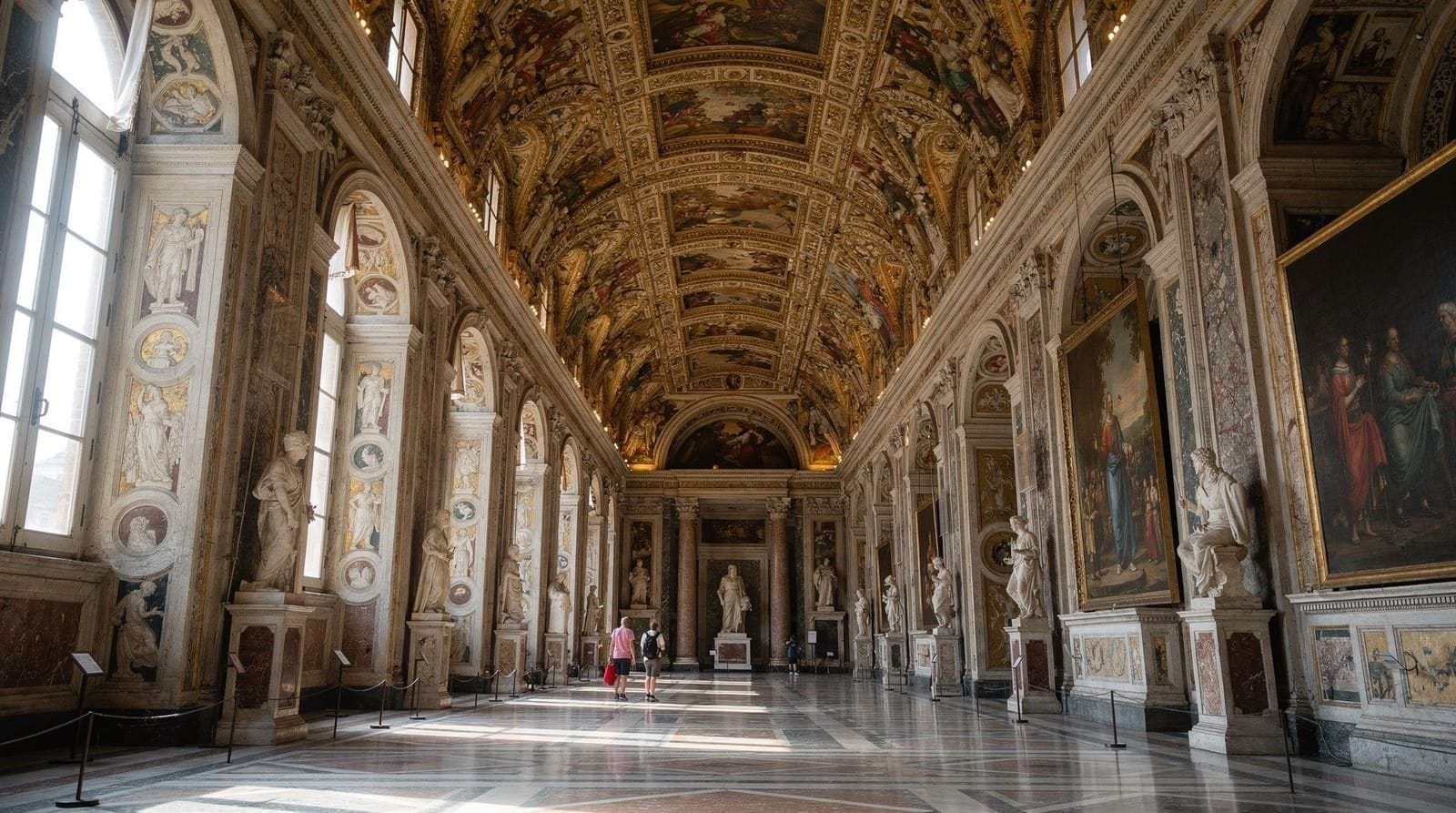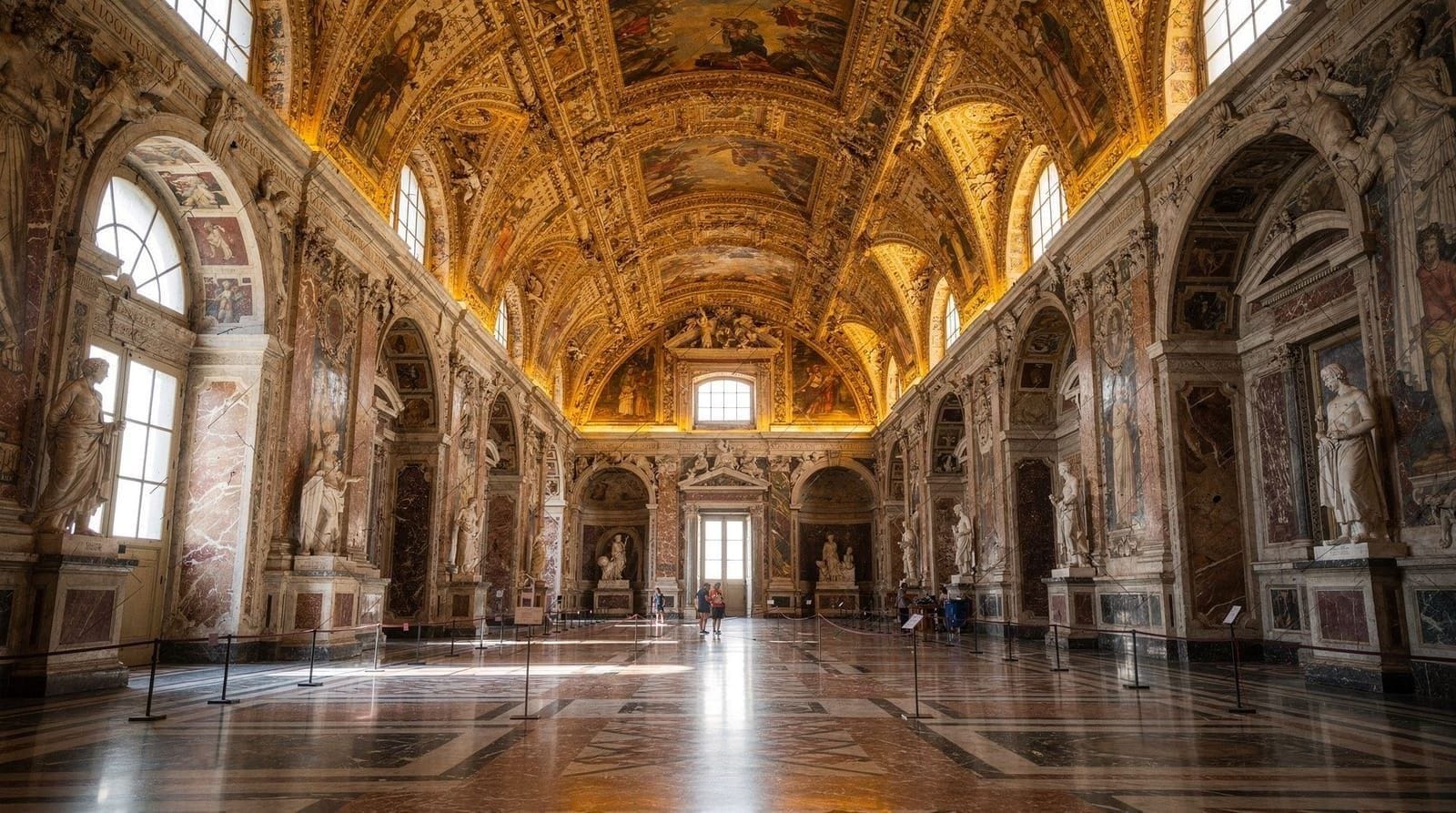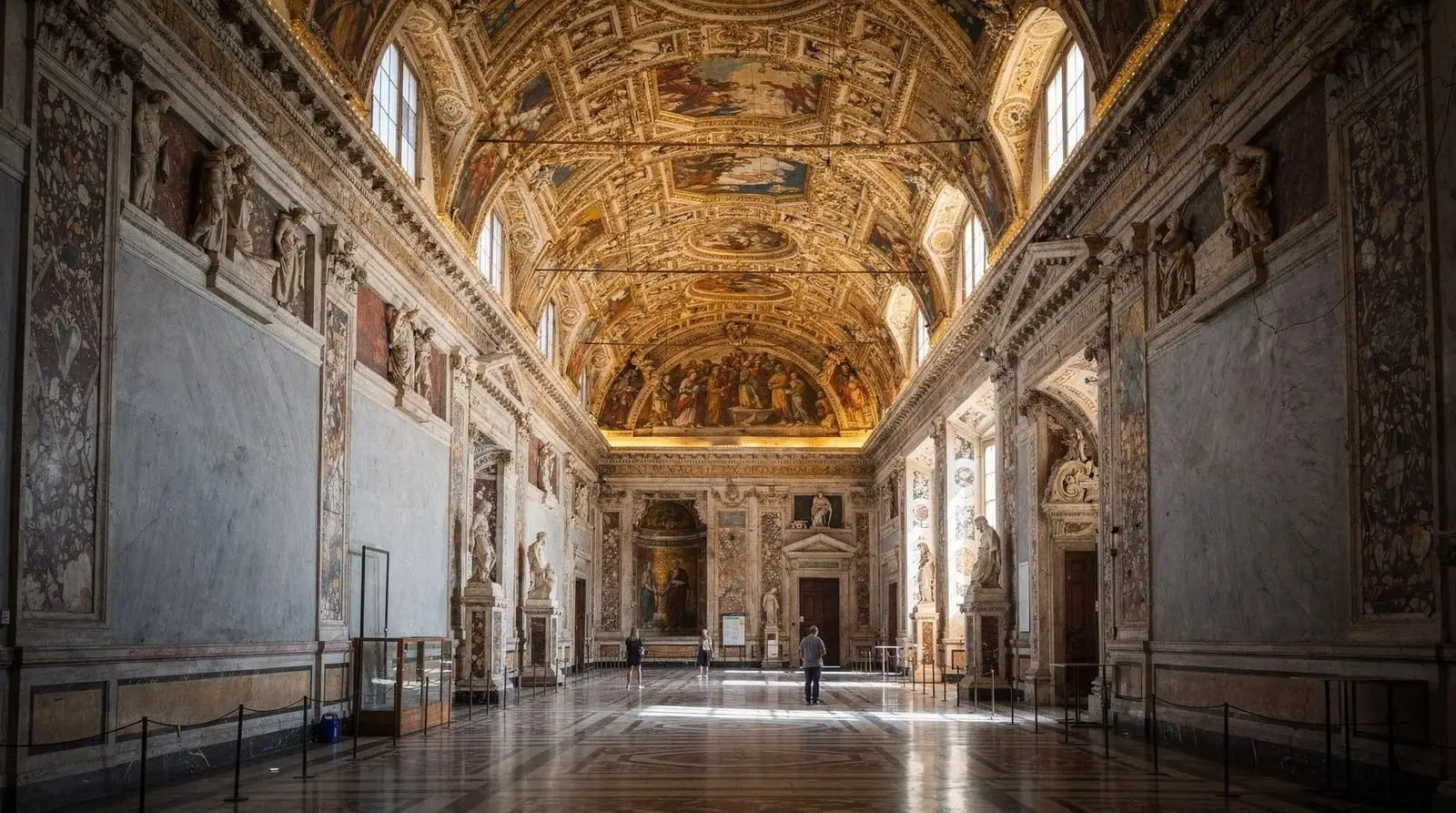
Raphael Rooms guide — what to see and understand in the Vatican's finest frescoes
Vatican Museums, Sistine Chapel & St. Peter's Basilica Tour
What are the Raphael Rooms in the Vatican?
The Raphael Rooms (Stanze di Raffaello) are four rooms in the Vatican Palace painted between 1509 and 1524 by Raphael and his workshop, commissioned by Pope Julius II and Leo X. The most famous is the Room of the Segnatura, containing the School of Athens — a group portrait of ancient philosophers set in an idealised Greek building, widely considered one of the masterpieces of the Italian Renaissance.
Before the Sistine Chapel: why the Raphael Rooms matter
Most visitors to the Vatican experience the Raphael Rooms as the antechamber to the Sistine Chapel — a beautiful prelude to the main event. This undersells them significantly. The Stanze di Raffaello are among the most important rooms in European art history, and the School of Athens alone would be a primary destination at any other museum in the world.
Raphael was 25 when Pope Julius II invited him to Rome in 1508 — the same year Michelangelo began the Sistine Chapel ceiling in the adjacent building. The two commissions were running simultaneously, and the rivalry between the two artists was real, if managed carefully by their papal patron.
Understanding what Raphael was doing — synthesising classical antiquity with Christian theology, creating a unified visual programme for a pope who saw himself as the heir of both Augustus and St. Peter — transforms the Rooms from beautiful decoration into an intellectual argument about power, knowledge, and faith. For the fuller context of the popes who commissioned all this, see our popes and papacy guide.
| Where | Apostolic Palace, mid-route in the Vatican Museums |
| Included in | Standard Vatican Museums ticket (no extra fee) |
| Time needed | 45–60 minutes for genuine engagement, 20 minutes rushed |
| Best time | 08:00 entry, reach the Rooms by 08:45–09:00 |
| Don’t miss | The School of Athens, Room of the Segnatura |
The four rooms: an overview
The Stanze consist of four rooms, each with a distinct programme. Visitors see them in a specific order; the sequencing matters.
Room of the Segnatura (1509–1511, entirely by Raphael) Room of Heliodorus (1511–1514, Raphael with workshop assistance) Room of the Borgo Fire (1514–1517, primarily workshop with Raphael’s designs) Room of Constantine (1517–1524, workshop, after Raphael’s death in 1520)
The quality decreases as workshop involvement increases. The Room of the Segnatura is the one to spend time in.
Vatican Museums guided tour — Raphael Rooms, Sistine Chapel, St. Peter’sRoom of the Segnatura (Stanza della Segnatura)
This was Julius II’s private library and the room where he signed official documents (hence “Segnatura”). It contains four wall-sized frescoes representing the four branches of human knowledge as understood in the Renaissance: Theology, Philosophy, Poetry, and Justice.
The School of Athens (Philosophy)
The most famous image: approximately 50 figures from ancient Greek philosophy arranged in a vast barrel-vaulted space (modelled on Bramante’s design for the new St. Peter’s Basilica, then under construction). At the centre, Plato points upward and Aristotle points forward — representing respectively the idealist (truth is eternal and abstract) and empiricist (truth is found in observed reality) traditions.
Hidden portraits in the School of Athens:
- Plato is painted as Leonardo da Vinci — the resemblance was recognised in Raphael’s time
- Heraclitus (the brooding figure in the foreground, left of centre) is a portrait of Michelangelo — painted by Raphael after he saw the Sistine Chapel ceiling, reportedly sneaking in while Michelangelo was absent
- Euclid (the geometer crouching lower right, demonstrating geometry with a compass) is a portrait of Bramante
- Raphael himself appears in the lower right corner in a self-portrait, next to his teacher Perugino
The architectural setting has no precedent in classical art — Raphael invented it. The columns, barrel vault, and receding perspective describe a building grander than anything that existed in 16th-century Rome.
The Disputation of the Holy Sacrament (Theology)
The wall facing the School of Athens. A celestial assembly of saints and Church Fathers contemplates the Eucharist on an altar below. The theological argument: the host on the altar is the physical point at which heaven and earth meet.
Note the symmetrical relationship between this painting and the School of Athens: philosophy occupies one wall, theology the other. Raphael’s programme is that these are not opposed but complementary — the philosophical tradition of Greece prepares the mind for Christian revelation.
Parnassus (Poetry)
Apollo on Mount Parnassus surrounded by the nine Muses and classical and contemporary poets. Dante, Homer, Virgil, Sappho, and others are identifiable. The window in this wall created a compositional challenge that Raphael solved by painting a curved landscape around the existing architectural opening.
Jurisprudence (Justice)
Three smaller scenes on the window wall: the Cardinal Virtues (Fortitude, Prudence, Temperance), Justinian receiving the Pandects (civil law), and Gregory IX receiving the Decretals (canon law). Less celebrated than the other walls but completing the intellectual programme.
Room of Heliodorus (Stanza di Eliodoro)
Julius II’s second apartment room. The iconographic programme is more political than philosophical — four scenes showing divine intervention to protect the Church from its enemies.
Expulsion of Heliodorus from the Temple
The most dynamic fresco in the Rooms: Heliodorus, a Syrian general who attempted to steal the treasure of the Jerusalem Temple, is struck down by heavenly horsemen. On the left, Pope Julius II watches from a portable throne (a contemporary portrait). The scene was painted in 1511, when Julius was conducting military campaigns to reassert papal territorial authority — the political message was transparent.
Liberation of St. Peter
Particularly notable for its treatment of light: three sources — the angel, the moon, and a torch held by soldiers — illuminate the scene simultaneously. Arguably Raphael’s most sophisticated night scene.
Mass of Bolsena
Pope Julius kneels witnessing the Miracle of Bolsena (1263): a doubting priest sees blood seeping from the host during Mass. Painted as Julius personally witnessed a contemporary version of the same miracle.
Attila Repelled by Leo the Great
Pope Leo I (depicted with the face of Leo X, Julius’s successor) confronts Attila the Hun. Apostles Peter and Paul appear in the sky brandishing swords. The immediate political meaning: Leo X repelling the French invasion of Italy.
Room of the Borgo Fire (Stanza dell’Incendio)
Raphael designed the four scenes but execution was largely by his workshop. The quality is lower; the rooms become more crowded as visitors rush toward the Sistine Chapel.
The most interesting panel: The Fire in the Borgo — a fire near St. Peter’s allegedly extinguished by Pope Leo IV’s blessing. The architectural background contains one of the earliest accurate depictions of the old Basilica of St. Peter’s before it was demolished by Julius II for the new one.
Practical advice for the Raphael Rooms
Time required
Allow 45–60 minutes if you want to understand what you are looking at. 20 minutes is the average for visitors rushing to the Sistine Chapel; 45 minutes with a focus on the Room of the Segnatura is the minimum for genuine engagement.
The crowd dynamic
The Rooms are less congested than the Sistine Chapel but still busy. The Room of the Segnatura typically peaks between 10:30 and 13:00. If you have a morning entry, the Rooms at 08:30 are significantly less crowded than at 11:00.
Vatican early morning tour — Raphael Rooms without the crowdsPhotography
Unlike the Sistine Chapel, photography is permitted in the Raphael Rooms without flash. The light is generally good for photographs; the fresco colours are vivid and the contrast between the vault decorations and the wall frescoes is visually strong.
Using a guide vs self-guided
The Raphael Rooms are the location where a guide makes the most difference in the Vatican. Without interpretation, the iconographic programmes are opaque — you see beautiful paintings but cannot read the argument they make. With interpretation, the Rooms become legible as a political and theological manifesto.
If you only have budget for one guided experience in the Vatican, spend it on a tour that includes the Raphael Rooms with substantive commentary.
The relationship between the Raphael Rooms and the Sistine Chapel
Raphael and Michelangelo were working simultaneously, 50 metres apart, for the same patron. They knew each other’s work was in progress.
The tradition that Raphael’s Heraclitus portrait of Michelangelo was painted after Raphael secretly viewed the Sistine ceiling is well documented — the figure was apparently added late in the Segnatura commission and the style differs from the rest of the painting. The School of Athens exists in a preparatory drawing without Heraclitus; he was added later.
Michelangelo reportedly complained that Raphael had “stolen” his style. The characterisation is oversimplified, but the Sistine ceiling’s monumental figure style did influence Raphael’s later work, particularly in the Room of Heliodorus.
The two commissions together constitute the highpoint of the High Renaissance — and they were created by two competitive, difficult men under enormous papal pressure, simultaneously, without any certainty that either would survive the commission. Understanding this makes the Rooms and the Chapel more interesting, not less.
Frequently asked questions about the Raphael Rooms
Are the Raphael Rooms included in the standard Vatican Museums ticket?
Yes — the Raphael Rooms are part of the main Vatican Museums route and included with the standard €18 entry ticket. They are on the path between the Gallery of Maps and the Sistine Chapel.
How much of the Raphael Rooms was actually painted by Raphael?
The Room of the Segnatura is entirely Raphael’s work. The Room of Heliodorus is mostly Raphael with workshop assistance. The later two rooms are increasingly workshop-executed from Raphael’s cartoons (designs). Raphael died in 1520 at age 37, leaving the Room of Constantine to his students.
What is the best way to photograph the School of Athens?
Use a wide-angle lens or the widest setting on your phone camera. The room is not large enough to capture the full fresco from a central position; you will need to shoot from the corner at an angle, which creates perspective distortion. The best full-room shots are from the doorway on the opposite side.
Can I visit the Raphael Rooms without the Sistine Chapel?
No — the Vatican Museums ticket and route includes both. The Rooms are mid-route; the Sistine Chapel is the endpoint. You cannot visit one without the other on a standard ticket.
Why are the rooms in a different building from the Sistine Chapel?
The Raphael Rooms are in the Apostolic Palace, the official papal residence. The Sistine Chapel is a separate building (the chapel of the papal court) adjacent to the Palace. They are connected internally for visitors but are architecturally distinct structures.
Is there an audio guide specifically for the Raphael Rooms?
The standard Vatican Museums audio guide includes commentary on the Raphael Rooms as part of its main route, though the detail is general rather than room-by-room in depth. For the level of interpretation that actually unlocks the iconographic programme, a live guide — either a small-group or private tour — makes a bigger difference here than almost anywhere else in the Vatican Museums.
Do the Raphael Rooms get as crowded as the Sistine Chapel?
No, though they are busier than most of the rest of the Museums. The Sistine Chapel is the single most congested room in the Vatican because every visitor’s route ends there; the Raphael Rooms, positioned just before it, absorb some of that same crowd building up but with more space to spread out and no photography restrictions adding friction.
Raphael’s early life and the commission: context for the rooms
Raphael Sanzio was born in Urbino in 1483, the son of a court painter. He trained under Perugino in Perugia — the same Perugino who painted frescoes on the walls of the Sistine Chapel in the 1480s, a generation before Raphael arrived in Rome. This training lineage matters: Perugino’s refined classical style, his mastery of spatial perspective, and his religious serenity are all visible in Raphael’s early work and evolved in the Vatican rooms.
Raphael arrived in Rome in 1508, invited by Julius II on the recommendation of Bramante (the architect redesigning St. Peter’s and the Vatican). Julius had hired Piero della Francesca’s student to begin the apartment frescoes; when he saw Raphael’s preliminary sketches, he reportedly ordered the existing work destroyed and gave Raphael the entire commission.
The decision was not obvious. Raphael was 25 and had never worked on anything of this scale. The Vatican apartment rooms were the private living and working spaces of the most powerful institution in Europe. The choice of an untested young artist over established masters suggests Julius had an eye for something beyond technical mastery — a vision of unified programmatic painting that the older generation could not deliver.
The preparatory drawings: understanding what Raphael changed
Preparatory drawings for the School of Athens survive in the Biblioteca Ambrosiana in Milan, the Albertina in Vienna, and the Uffizi in Florence. Comparing them to the finished fresco reveals significant changes between initial conception and final execution.
Most significantly: the central group of Plato and Aristotle changed position and gesture multiple times. Earlier drawings show Aristotle (representing empirical philosophy, pointing forward) in a more dominant position; the final fresco balances the two figures more equally. This reflects Raphael’s evolving understanding of Julius II’s intellectual position — Julius wanted a synthesis of classical and Christian thought, not a hierarchy.
The Heraclitus figure (Michelangelo’s portrait) does not appear in the preparatory drawings. He was added after the main composition was established, based on visual analysis of the painting’s surface layers. The traditional date for this addition — after Raphael first saw the Sistine ceiling in 1511 — remains widely accepted but unverified.
The figure of Raphael himself (lower right, with Perugino beside him) was also added late. The self-portrait is identified by comparison with other authenticated portraits of Raphael. His expression — turning toward the viewer with a slight smile — is the most self-conscious moment in the entire Vatican programme.
The Room of Constantine: Raphael’s death and the unfinished legacy
The Room of Constantine was Raphael’s last commission — he designed it but died in 1520 at age 37 before any painting began. His death, on Good Friday of his 37th birthday (2 April 1520), stopped work. His students — Giulio Romano, Perin del Vaga, and Francesco Penni — executed the room from his designs between 1520 and 1524.
The four scenes depict Emperor Constantine I and his relationship with Christianity: the Vision of the Cross (before the Battle of Milvian Bridge, 312 AD), the Battle of Milvian Bridge itself, the Baptism of Constantine, and Constantine’s Donation (the legendary land grant to Pope Sylvester I).
The political programme is explicit: the Room of Constantine was painted under Pope Clement VII, who needed to assert the legitimacy of papal temporal power at exactly the moment when both Luther’s Reformation and the French military threat were questioning it. The depiction of a Roman emperor subordinating himself to the Church provided historical precedent.
Art historians generally rate the Room of Constantine as significantly weaker than the first two rooms — the hands of Giulio Romano and others are identifiable, and Raphael’s unified vision is absent. The massive battle scene has an energy that borders on chaos compared to the controlled spatial drama of the School of Athens.
Practical recommendation for visitors: If time in the Raphael Rooms is limited, spend it in the Room of the Segnatura (School of Athens) and the Room of Heliodorus. The Room of Constantine can be walked through quickly without significant loss.
How to plan your Vatican Museums visit around the Raphael Rooms
The Raphael Rooms are mid-route in the Vatican Museums: after the Egyptian Museum, after the Gallery of Maps, before the Sistine Chapel. This position creates a crowd accumulation problem — everyone who entered at 08:00–10:00 converges on this section simultaneously by 10:00–11:30.
The ideal strategy: Book 08:00 entry, move quickly through the Egyptian Museum (20 minutes) and Gallery of Maps (15 minutes), and reach the Raphael Rooms by 08:45–09:00. At this time, many other 08:00 visitors are still in the earlier galleries. You get 30–40 minutes in the Rooms before the compression begins.
The guided tour advantage: With a guide who knows the route, you are taken directly to the key elements in each room without the navigational overhead of a self-guided visit. In the Room of the Segnatura, a guide positions the group at the optimal distance (centre of the room, approximately 5 metres from the fresco) and covers the School of Athens in 10 focused minutes — more effective than 30 minutes of undirected looking.
For booking options that ensure the best Raphael Rooms timing, see the Vatican skip-the-line tickets guide. For a broader look at when the Vatican Museums overall are least crowded, see the Vatican best time to visit guide; for a genuinely quiet first hour, the Vatican early access breakfast tour opens before the general public.
The Raphael Rooms vs the Sistine Chapel: which deserves more of your time
Visitors under time pressure often shortchange the Raphael Rooms to save energy for the Sistine Chapel, and the reverse rarely happens. Both deserve real attention, but for different reasons — the Sistine Chapel overwhelms through scale and the sheer ambition of Michelangelo’s ceiling, while the Raphael Rooms reward close, patient looking at a human scale you can actually engage with sentence by sentence. If you can only budget one unhurried stop on a rushed visit, the Room of the Segnatura is the better use of 20 focused minutes than a further 20 minutes staring up at the Sistine ceiling once you’ve absorbed its main scenes — you have already seen the ceiling’s core impact within the first five minutes; the School of Athens keeps giving up detail for much longer.
Beyond the Vatican: Raphael and Rome’s wider art trail
Raphael’s work in Rome extends beyond the Vatican Palace. The Villa Farnesina in Trastevere has his Loggia of Psyche and Galatea frescoes, painted for the banker Agostino Chigi, in a far less crowded setting than the Vatican. Santa Maria del Popolo holds the Chigi Chapel, designed by Raphael as an architectural and sculptural ensemble rather than a fresco cycle. Neither is covered by the Vatican Museums ticket, so treat them as a separate half-day for anyone building a fuller Raphael itinerary in Rome. Pairing this with Rome’s other great fresco tradition, our Caravaggio trail guide and Rome’s basilicas and Caravaggio guide cover the darker, more dramatic counterpoint a century later — useful context for understanding how far Roman painting moved in the century after Raphael’s death. The broader sweep of Roman history that shaped both eras is in our Rome history guide.
Top experiences
Bookable activities with verified prices and instant confirmation on GetYourGuide.